
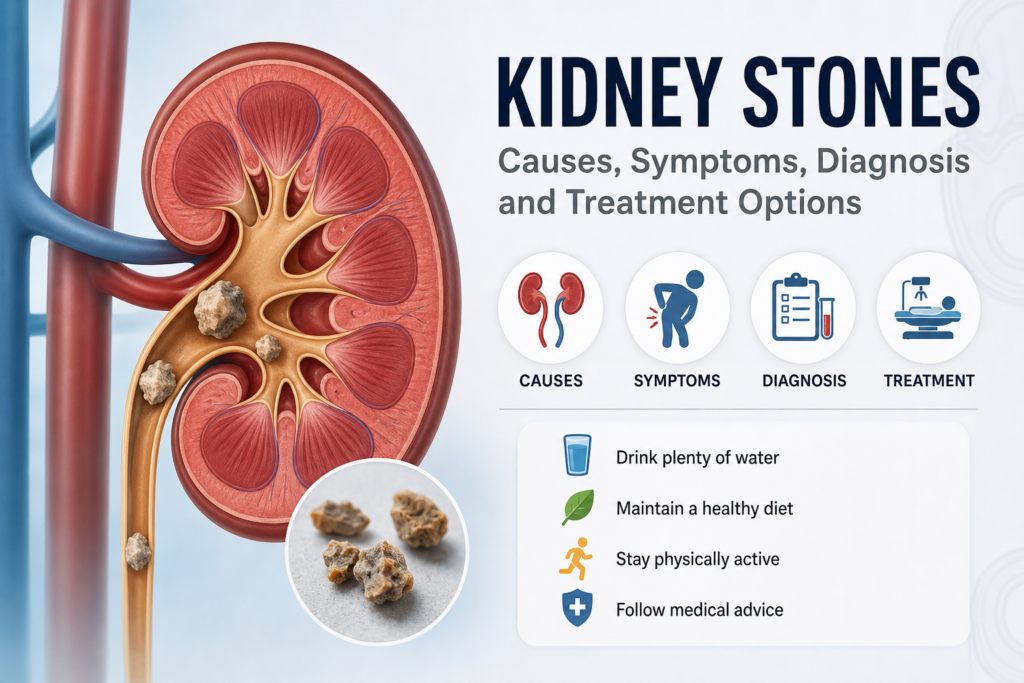
Kidney stones are a common urinary system problem that can affect people of different ages. They develop when certain minerals and salts present in urine become concentrated and form hard crystals inside the kidneys. Some kidney stones are very small and may pass through the urinary tract without causing major problems, while larger stones can cause significant pain and may need medical treatment.
Understanding the causes, symptoms, diagnosis, and available treatment options can help you recognize the condition early and seek appropriate care.
What Are Kidney Stones?
Kidney stones are solid, crystal-like deposits that form when substances such as calcium, oxalate, uric acid, or other minerals become concentrated in the urine. Normally, these substances remain dissolved and leave the body through urine. When their concentration increases, crystals can form and gradually grow into stones.
The size and location of a kidney stone can influence the symptoms it causes. A small stone may pass naturally, while a larger stone can become stuck in the urinary tract and interfere with normal urine flow.
What Causes Kidney Stones?
Several factors can contribute to the formation of kidney stones. One of the most common is inadequate fluid intake. When you do not drink enough water, your urine becomes more concentrated, which can increase the chance of crystal formation.
Other possible factors include:
- High intake of salt
- Certain dietary patterns
- Excessive consumption of foods containing oxalates
- Family history of kidney stones
- Obesity and certain metabolic conditions
- Recurrent urinary tract infections in some cases
- Certain medical conditions
- Some medications
- Previous history of kidney stones
Having one or more of these factors does not necessarily mean that a person will develop kidney stones. A healthcare professional can help identify individual risk factors.
What Are the Symptoms of Kidney Stones
The symptoms of kidney stones can vary depending on their size and location. Some stones may not cause any symptoms until they move into the ureter, the tube that carries urine from the kidney to the bladder.
Common symptoms may include:
- Sharp pain in the side or back
- Pain that may move toward the lower abdomen or groin
- Pain or burning during urination
- Frequent or urgent need to urinate
- Blood in the urine
- Nausea or vomiting
- Cloudy or unusual-smelling urine
The pain caused by a kidney stone can sometimes come and go as the stone moves through the urinary tract.
Fever or chills along with urinary symptoms may indicate an infection and should not be ignored. Prompt medical attention is important in such situations.
How Are Kidney Stones Diagnosed?
When kidney stones are suspected, a doctor may ask about symptoms, previous stone episodes, dietary habits, and medical history. A physical examination may also be performed.
Depending on the situation, diagnostic tests may include:
- Urine Tests
- Urine testing can help identify blood, signs of infection, or substances that may contribute to stone formation.
- Blood Tests
- Blood tests may be recommended to assess kidney function and check levels of certain substances associated with stone formation.
- Ultrasound
- Ultrasound can help detect many kidney stones and assess whether there is any blockage in the urinary system.
- CT Scan
In some cases, a CT scan may provide more detailed information about the size and location of a stone, particularly when symptoms are significant or the diagnosis is uncertain.
The choice of diagnostic test depends on the person’s symptoms and clinical situation.
Kidney Stone Treatment Options
Treatment depends on several factors, including the size and location of the stone, symptoms, whether there is a blockage or infection, and the person’s overall health.
Observation and Medical Management
Small stones may pass naturally through the urinary tract. A doctor may recommend adequate fluid intake and medicines to manage pain or other symptoms. In selected cases, medication may also be prescribed to help facilitate stone passage.
It is important not to assume that every stone will pass naturally. Medical assessment can help determine whether observation is appropriate.
Shock Wave Treatment
Shock wave procedures can be used for certain kidney stones. The treatment uses focused energy to break the stone into smaller pieces, which can then pass through the urinary tract.
Whether this option is suitable depends on factors such as stone size, location, and composition.
Ureteroscopy and Laser Treatment
For some stones, a procedure called ureteroscopy may be recommended. During this procedure, a small instrument is passed through the urinary tract to reach the stone. A laser may then be used to break the stone into smaller fragments, which can be removed or allowed to pass.
This approach may be considered when a stone is unlikely to pass on its own or when other treatment options are not suitable.
Surgical Treatment
Larger or complex kidney stones may require a surgical procedure to remove them. The choice of procedure depends on the stone’s characteristics and the patient’s individual condition.
A urologist can recommend the most appropriate approach after evaluating the stone and overall health.
Can Kidney Stones Be Prevented?
Although kidney stones cannot always be prevented, certain lifestyle measures may help reduce the risk of developing them again.
Drinking enough water throughout the day is important because it helps dilute substances in the urine. Maintaining a balanced diet and limiting excessive salt intake may also be beneficial.
People who have experienced recurrent kidney stones may need a more detailed evaluation. Depending on the type of stone, a doctor may recommend dietary changes or other preventive measures.
If a stone is removed, testing its composition can sometimes provide useful information about why it formed and how future stones may be prevented.
When Should You Consult a Urologist?
Persistent or severe pain, blood in the urine, difficulty passing urine, repeated urinary symptoms, or suspected kidney stones should be evaluated by a healthcare professional.
Immediate medical attention may be needed if kidney stone symptoms occur along with fever, chills, vomiting, or difficulty passing urine, as these symptoms can sometimes be associated with complications
For people seeking Kidney Stone Treatment in Baner, a consultation with a urologist can help determine the cause of symptoms, assess the stone, and discuss suitable treatment options.
Conclusion
Kidney stones can range from small stones that pass naturally to larger stones that require a procedure. Recognizing the symptoms and getting an appropriate diagnosis can help guide treatment.
Drinking adequate water, maintaining healthy dietary habits, and following medical advice can also help reduce the risk of recurrent stones. If you experience symptoms that may be related to kidney stones, timely evaluation can help determine the most suitable next step.